Tag: ELN

5 Benefits of Using an Electronic Lab Notebook
The biologics development process is a data-driven endeavor. A vast amount of data is generated from many teams with the hopes of answering questions and informing decision-making along the way. Centralizing this data and their analyses across experiments amplifies the power and impact that data has on biologics research and development.
Of course, centralizing biologics assay data means much more than simply storing data in the same place. Data centralization increases the value of biologics data beyond one particular experiment or result by defining data relationships. The ability to aggregate data across multiple samples, assays, and experiments, with metadata describing the relationship of all of these to each other, is where modern data science resides. Whereas the analysis of a single value from a single assay shows a distribution, joining that assay with others reveals a richer data landscape that is ripe for analysis. These data landscapes yield even more insights when they are related to one another across many controlled variables and conditions.
Below are more ways that implementing tools and strategies for data centralization can impact the speed and efficiency of biotherapeutic development.
Data Integrity
Having a single source of truth for data makes it easier for organizations to track how (and by whom) data is generated, accessed, and modified. With the assistance of a biologics data management application serving as a central hub- permissions, auditing, and backups provide control over how, when, where, and by whom data is used. Centralization of data also encourages standardization of data formats across research teams. Standardizing data structures helps validate the data being entered and helps preserve the relationships between data. This leads to downstream efficiency and maximizes the utility of experiments beyond the individual or team from which it was derived.
Collaboration
Centralizing biologics research data also helps promote collaboration between research teams. By storing data in one central location in standardized formats, scientists can easily find, compare and reference existing data in their research. A central repository for data also makes it much easier to see what data is missing or needed to inform decisions. Hand-offs of data are also made easier when all data is centrally stored.
About our Biologics LIMS
LabKey Biologics provides researchers with a set of tools to centralize biological entity registration, workflow management, and data exploration.
- Bioregistry – Register and track molecular entities, nucleotide sequences, protein sequences, expression systems, constructs, vectors, and cell lines
- Biologics Assay Management – Connect design data to related multi-dimensional assay results for a complete data landscape.
- Biologics Workflow Manager – Centrally manage biologics development workflows to help your team collaborate
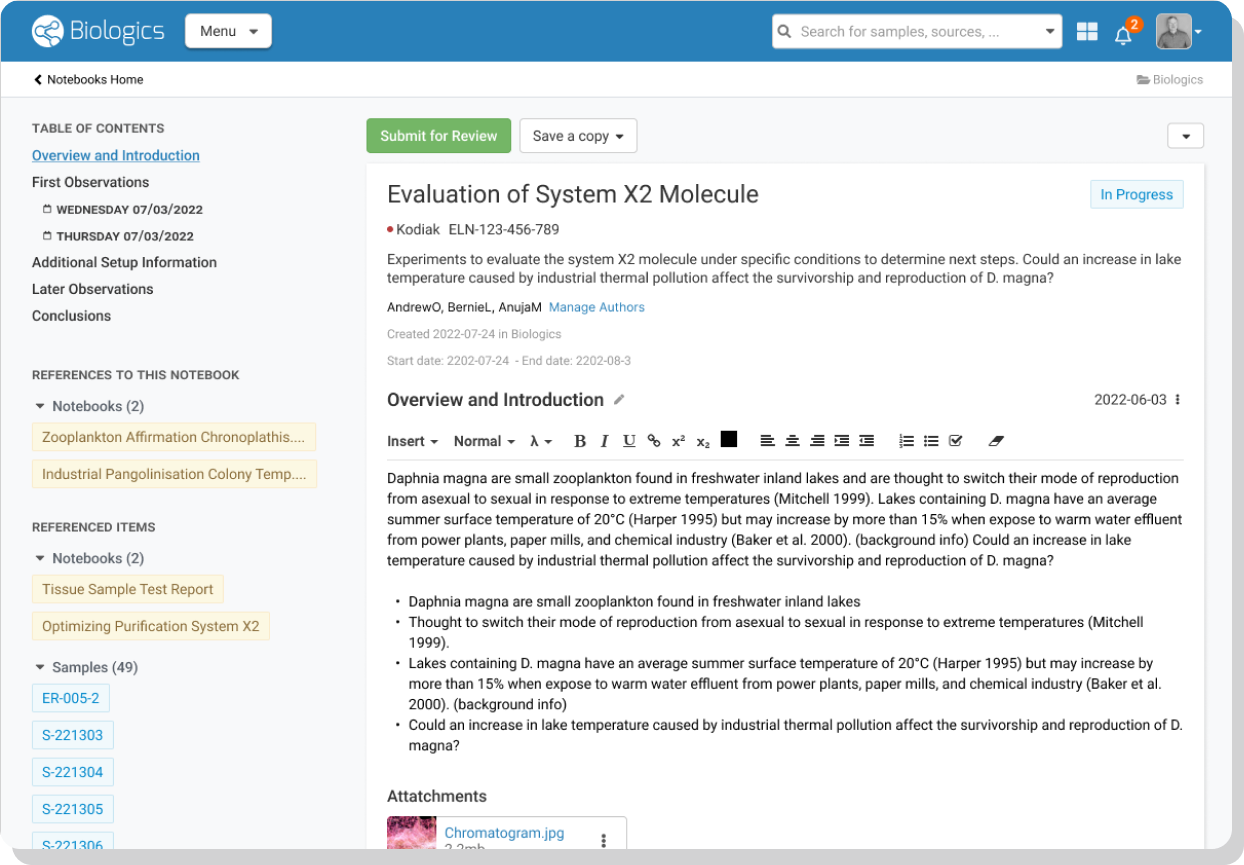
- Electronic Lab Notebook – Highlight and connect your research entities and data with our biologics ELN
Click Here to take a tour of LabKey Biologics.
5 Electronic Lab Notebook Features Scientists Can’t Live Without

 An ELN (electronic lab notebook) is an essential software tool for documenting experiments, reviewing compiled results, detailing meaningful conclusions, and collaborating with team members. As scientists work with increasing volumes of data, concerns over data reproducibility, data integrity, intellectual property and security/compliance have led to the wide ELN adoption in nearly every scientific discipline. Once viewed as little more than a paper-on-glass/word-processing application, ELN features have grown to meet the complexities of modern-day research. Below we outline some essential ELN features to look for when evaluating an electronic lab notebook for your organization.
ELN Feature Areas to Consider:
1- Ease of use
The ELN you choose should be easy to use and implement. This is especially critical in driving adoption within the organization. That means the user interface should be intuitive for common functions. Ideally, your new ELN should not require extensive training to learn nor require sophisticated integrations with other software to be useful.
2- Templates
The ability to create and use templates of common notebook forms saves time by reducing duplicative work. The ability to quickly modify templated entry types is an essential feature for saving time and improving overall work satisfaction. By creating templates for specific scenarios such as purifications, cell passaging, or repeated analytical work, your team can save time and standardize the formatting of notebook entries.
3- Data Links/Connection
Compiling data for meaningful write-up and conclusions should not require a huge investment of time and effort. By far the easiest way to surface data is for your ELN to have direct access to your underlying data management system that captures the data. This puts your relevant data at your fingertips while authoring and only external data will require effort to incorporate. Directly referencing data not only saves time, it also promotes data integrity and ensures that valuable data remains at the forefront of the decision-making process during the R&D lifecycle.
4- Attachments and Images
External files and images are important components of complex workflows. It should be easy to incorporate them into notebook entries in various formats such as pressure traces, spreadsheets, images, CoA’s or other QC documents, and SOP’s. The ability to bind these files with your signed notebook contents and view the attachments with a notebook entry can also be a huge time saver.
5- Collaborative Features
In the highly collaborative research environments of today, it is essential to have an ELN that makes it easy to work with other contributing scientists. The ELN should support collaborative authoring and a streamlined sign-off/review process for notebooks. It should be easy to find the notebooks that need your attention, comment or review. You should also receive reminder notifications for these actions when you aren’t in the application. These collaborative features facilitate important discussion and encourage timely and accurate documentation of work.
About the Biologics LIMS ELN
Biologics LIMS includes a full-featured electronic lab notebook seamlessly integrated with the Bioregistry, Assay Data and Workflow Management tools. This user-friendly ELN allows scientists to:
- Save time authoring and reviewing notebooks with templates, notifications and an intuitive interface
- Highlight valuable data by linking directly to bioregistry entities, samples and assays
- Collaboratively document and discuss notebook entries and referenced data
Click here to learn more about LabKey Biologics.